I provide, technical articles, civil engineering standard, construction standards, testing methods, FAQ, MCQ, new idea, Questions, complaint handling, general notes, Drawings, helping tips, open discussion, decision making idea, where is wrong, what is right, high rise building, tile and adhesive, grouts, concrete repair mortar, epoxy flooring, Polyurethane floorings and many other construction chemical related answers. Helping students, job interview questions, site works, application video.
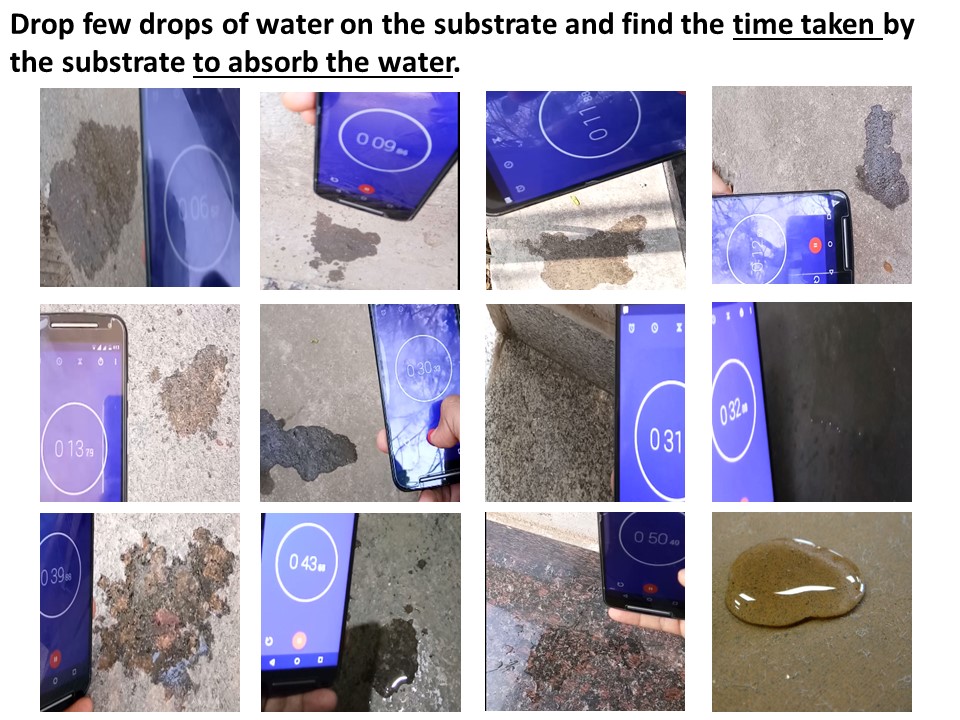
This same method is also mention in standard ISO 13007 - 2 - Appendix A - Measurement of water absorption. From these values, we can decide the subsequent application product nature, Ex.. the material used to bond should have water retention strength, Coverage of top coating material, Spreadability of the material, Stain catching time, Cleaning time, etc.
Let see how may types of solids are there in liquid products or materials:
Total solids - includes all solids present in a water sample. Determined directly by evaporating a known volume of an unfiltered water sample in a 105 Deg C oven.
Total dissolved solids - includes all solids present in a water sample filtered through a 1.2 m m filter. Determined by evaporating a known volume of the filtrate sample in a 105 Deg C oven.
Total suspended solids - includes all solids present in a sample that remain on a 1.2 m m filter. Determined by filtering a known volume of sample and placing the filter and filter container in a 105 Deg C oven for 24 hours to evaporate the water.
Fixed solids - solids that remain after firing a sample in a 550 Deg C muffle furnace. Can be performed on total, dissolved, or suspended samples to determine - total fixed solids, fixed dissolved solids, or fixed suspended solids.
Volatile solids - solids that removed by firing a sample in a 550 Deg C muffle furnace. Can be performed on total, dissolved, or suspended samples to determine - total volatile solids, volatile dissolved solids, or volatile suspended solids.
As per IS 101 ( Part 8/&e 6 ) : 1993
– Volume Solids can be measured as follows:
1. Take Stainless Steel Disc 60
mm diameter and 0.70 mm thickness with a small hole 2 to 3 mm from the edge,
with the hole and string to hang in the testing cabinet.
2. Note the weight of the
stainless-steel disc. Dry the disc in an oven at 105°C for 10 minutes and cool.
Weigh the disc in air. Let it be W1, grams. Suspend the disc in water and weigh
again. Let it be W2 grams. Volume of the
disc V = (w1-W2) / d, the density of water.
3. Determine the weight of
non-volatile content of the liquid coating material by drying a known amount of
paint at 105°C for 3 hours. Let it be W grams.
4. Determine the specific gravity
of the paint using mass per litre cup. Let it be P.
5. Dip the disc in the paint sample for 10 minutes and take out the
disc. Allow the excess coating material to drain off. Blot the coating material
off the bottom edge of the disc so that beads or drops do not dry on the bottom
edge of the disc. Dry the disc at 105°C for 3 hours and cool. Weigh the coated
disc in air. Let it be W3, grams.
6. Suspend the coated disc in water and weigh again. Let it be W4
grams. Volume of the coated disc V1 = (W3-W4) / d, the density of water. Volume
of the dried coating = Vd = V1- V. Volume of wet coting = VW = (W3-W1)/(WxP).
7. Volume of solids = ((V1-V)/VW) x 100OR (Vd / VW) X 100.
As per ASTM D 2697, test method is intended to provide a measure of the
volume of dry coating obtainable from a given volume of liquid coating. This
value is useful for comparing the coverage (square feet of surface covered at a
specified dry film thickness per unit volume) obtainable with different coating
products.
For various reasons the value obtained may not be equal to that predicted from
simple additivity of the weights and volumes of the raw materials in a
formulation. One reason is that the volume occupied by a solution of resin in
solvent may be the same, greater, or less than the total volume of the separate
ingredients: such contraction or expansion in resin solutions is governed by a
number of factors, one of which is the extent and direction of spread between
solubility parameters of the resin and solvent.
The spatial configuration of the pigment particles and the degree to which the
spaces between the pigment particles are filled with the binder also affect the
volume of a dry coating formulation. Above the critical pigment volume
concentration, the apparent volume of the dry film is significantly greater
than theoretical due to the increase in unfilled voids between pigment
particles. The use of volume nonvolatile matter values in such instances should
be carefully considered as the increased volume is largely due to air trapped
in these voids.
Apply a coating of the mixed material as per manufacturer’s
specification.
There is one term we all come across called TSS, Total Suspended Solids. This can be tested using IS 3025 - part 17. Let see how to test the TSS:
This practice covered the determination of the time from
the initial mixing of the reactants of a thermosetting plastic composition to
the time when solidification commences, under conditions approximating the
conditions of use. This practice also provided a means for measuring the
maximum temperature reached by a reacting thermosetting plastic composition, as
well as the time from initial mixing to the time when this peak exothermic
temperature is reached. It was limited to reacting mixtures exhibiting gel
times greater than 5 min.
This test method offers a means of comparing the relative linear shrinkage and coefficient of thermal expansion.The material to be tested is placed in the mold in a fluid or plastic state. As the material makes a transition to a solid state, it adheres to and captures the end studs. The linear shrinkage measured is the change in length that occurs after the material is rigid enough and strong enough to move the studs. This test method can be used for research purposes to provide information on linear changes taking place in the test materials. Other dimensional changes may occur that do not manifest themselves as changes in length.
ASTM C-39 Standard Test Method for Compressive Strength of
Cylindrical Concrete Specimens and ASTM C-617Standard Practice for Capping
Cylindrical Concrete Specimens
Compressive Strength of Cylindrical Concrete Specimens
Part-3. ASTM C39/AASHTO T22
*Scope*
This test method covers determination of compressive
strength of cylindrical concrete specimens such as molded cylinders and drilled
cores. It is limited to concrete having a density in excess of 800 kg/m3 [50
lb/ft3]. The program requires a working knowledge of the following ASTM test
methods and practices.
Referenced Documents.
• C31/C31M Practice
for Making and Curing Concrete Test Specimens in the Field
• C42/C42M Test Method for Obtaining and Testing Drilled
Cores and Sawed Beams of Concrete
• C192/C192M Practice for Making and Curing Concrete Test
Specimens in the Laboratory
• C617 Practice for Capping Cylindrical Concrete Specimens
• C670 Practice for Preparing Precision and Bias Statements
for Test Methods for Construction Materials
• C873 Test Method for Compressive Strength of Concrete
Cylinders Cast in Place in Cylindrical Moulds
• C1077 Practice for Laboratories Testing Concrete and
Concrete Aggregates for Use in Construction and Criteria for Laboratory
Evaluation
• C1231/C1231M Practice for Use of Unbonded Caps in
Determination of Compressive Strength of Hardened Concrete Cylinders
• E4 Practices for Force Verification of Testing Machines
• E74 Practice of Calibration of Force-Measuring Instruments
for Verifying the Force Indication of Testing Machines.
The results obtained by this test method should serve as a
guide in, but not as the sole basis for, selection of a chemical-resistant
material for a particular application. No attempt has been made to incorporate
in the test method all the various factors which may affect the performance of
a material when subjected to actual service.
This is not a test
for permeability and the test results are not to be interpreted as a
measurement of, or indication of, the permeability properties of the materials
tested.
As per IS 516, test specimens cubical in shape shall be 15×15×15 cm. If the largest nominal size of the aggregate does not exceed 2 cm, 10 cm cubes may be used as an alternative. Cylindrical test specimens shall have a length equal to twice the diameter. They shall be 15 cm in diameter and 30 cm long. Smaller test specimens shall have a ratio of diameter of specimen to maximum size of aggregate of not less than 3 to 1, except that the diameter of the specimen shall be not less than 7.5 cm for mixtures containing aggregate more than 5 percent of which is retained on IS Sieve 480.
The cylindrical mould shall be of 150mm diameter and 300mm height conforming to IS: 10086-1982*. The mould and base plate shall be coated with a thin film of mould oil before use, in order to prevent adhesion of the concrete.
The ends of all cylindrical test specimens that are not plane within 0.05mm shall be capped. Capped surfaces shall not depart from a plane by more than 0.05mm and shall be approximately at right angles to the axis of the specimens.Capping shall be of neat cement or sulphur or hard plaster.
As per ISO 1519 OR as per ASTM D 522 Paints and varnishes — Bend test (cylindrical mandrel) shall be carried out.
This test procedure for assessing the resistance of a coating of paint, varnish or related product to cracking and/or detachment from a metal or plastics substrate when subjected to bending round a cylindrical mandrel under standard conditions. For a multi-coat system, each coat can be tested separately or the complete system can be tested.
The method specified can be carried out either as a “pass/fail” test, by carrying out the test with a single specified size of mandrel, to assess compliance with a particular requirement; or by repeating the procedure using successively smaller mandrels to determine the diameter of the first mandrel over which the coating cracks and/or becomes detached from the substrate.
Two types of apparatus are specified,
type 1 being appropriate for use on test panels of thickness up to 0,3 mm, and
type 2 for use on test panels of thickness up to 1,0 mm. Both types of apparatus have been found to give similar results with the same coating, but normally only one will be used for testing a given product. Also known as CYLINDRICAL BEND TEST to know the crack
bridging, elasticity, elongation, flexibility of coating in LAB.
This is a standardized and popular corrosion test method,
used to check corrosion resistance of materials and surface coatings. Usually,
the materials to be tested are metallic and finished with a surface coating
which is intended to provide a degree of corrosion protection to the underlying
metal.