Total Viewers

Translate

Search This Blog

Sunday, April 7, 2019

Steel in construction

Steel is combination of iron, carbon (0.10 - 1%), manganese (<1.6%), Phosphorus (<0.6%), sulfur (<0.6%), silicon (<0.6%) and together with 20 + alloys.  Alloys were added to molten steel to produce the steel of different characteristics.. say: hardness, tensile, ductility, toughness, etc. 

Actually, steel products were produced in 3 stages: 
   1. Iron ore (hematite + Fe2O3 + magnetite + Iron carbonates + silicates + Sulfides) +coal +lime stone converted to Pig iron in blast furnace.
   2. Pig iron to steel 
   3. Steel to steel products. 

Classification of steels:
   A. Mild steel or low carbon steel: carbon content of up to 0.25%.
   B. Medium carbon steel or carbon steel: carbon content of 0.3-0.6%. 
   C. High carbon steels: carbon content of more than 0.6%. 
   D. Alloy steel: When elements other than Mn and Si are present.
   E. Stainless Steel: When certain elements, such as Cr and Ni are added.

Steel shall be subjected to the following important test:
   a. Tensile test
   b. Torsion test - Shear modulus
   c. Charpy V-Notch impact test - toughness
   d. Bending test - Ductility
   e. Hardness test

In construction, the steel is used as 
a. Structural steel (Sections and pipes) - beam, columns, truss, frames, bracing, etc.
  

b. Reinforcement steel - reinforcement bars


Structural steel 
Structural steel is used as Sections and pipes as follows:
a. American Standard Beam (S-Shaped)S beam, S12x50 represents a beam that’s 12 inches deep and weighs 50 pounds per foot.
b. Angle (L-Shaped)are typically used in floor systems because of the reduced structural depth.
c. Bearing Pile (H-Shaped) - bearing piles are H-shaped to effectively transfer loads through the pile to the tip. Bearing piles work best in dense soils that offer most resistance at the tip. Individual piles can bear more than 1,000 tons of weight.
d. Channel (C-Shaped)C-shaped beams are cost-effective solutions for short- to medium-span structures. Channel beams were originally designed for bridges, but are popular for use in marine piers and other building applications.
e. Hollow Steel Section (HSS)Metal profile that has a hollow, tubular cross section. HSS units can be square, rectangular, circular, or elliptical. HSS structures are rounded, with radius that are about twice the thickness of the wall. These are commonly use HSS sections in welded steel frames for which units experience loading in different directions.
f. I-BeamI Beam, also known as an H beam or a universal beam, very effective at carrying shear and bending loads in the web’s plane.
g. PipeStructural steel pipes are important for a variety of construction applications, lending strength and stability. Pipes are hollow, cylindrical tubes that come in a variety of sizes, used to meet the needs of water, oil, and gas industry projects.
h. TeeA T beam is a load-bearing beam with a T-shaped cross section can withstand large loads but lack the bottom flange of the I Beam, giving it a disadvantage in some applications. 
i. Custom ShapesToday structural steel is not limited to using only the most common shapes. Custom metal fabrication opens the doors to a variety of special structural steel shapes for any type of project.
For more details about the shape and dimension of the structural steel as per AICS, please visit the following link: https://www.engineersedge.com/materials/aisc_structural_shapes/aisc_structural_shapes_viewer.htm


Reinforcement steel
Reinforcing steel is manufactured in different forms as follows: 

A. Un-coated steel
  1. Mild steel ribbed bars 
  2. High Yield Strength Deformed (HYSD) bars 
  3. Cold-twisted deformed (CTD) bars (TOR steel)
  4. Thermo Mechanically Treated (TMT) or Quenched & Self-Tempered (QST) steel
  5. Stainless steel
  6. Prestressing steel 


B. Coated steel
  1. Epoxy coated steel: Straight and bend bars can be applied with epoxy coating. Bars must be bent before epoxy-coating is applied. Bars shall be made free from rust before applying epoxy coating. Multiple layers of epoxy coating  may be required, at least 2 coats. This will work in terms of Fusion bonded. In case, cutting happens after the coating, make sure to coat at the end also.

It is more dangerous to use damaged epoxy-coated steel than conventional un-coated steel


  2. Galvanized steel: Initial stable corrosion product with Calcium hydroxyzincate (at pH < 13.3).  Zinc’s corrosion products are loose, powdery minerals that are less voluminous than iron corrosion products and are able to migrate away from the galvanized rebar surface into the adjacent concrete matrix. As a result, corrosion of the zinc coating causes very little physical disruption to the surrounding concrete.  
Substantially higher chloride threshold (2-4 times) for zinc coating. Zinc has a much greater pH passivation range than steel, making galvanized rebar resistant to the pH lowering effects of carbonation as the concrete ages. Even when the zinc coating does start to corrode, its corrosion rate is considerably less than that of uncoated steel.

C. Fiber Reinforced Polymer (FRP) bars / laminates

Lets us go in detail:
(CTD) Cold Twisted Deformed bars OR TOR (Toristeg  Steel Corporation of  Luxembourg) bars:
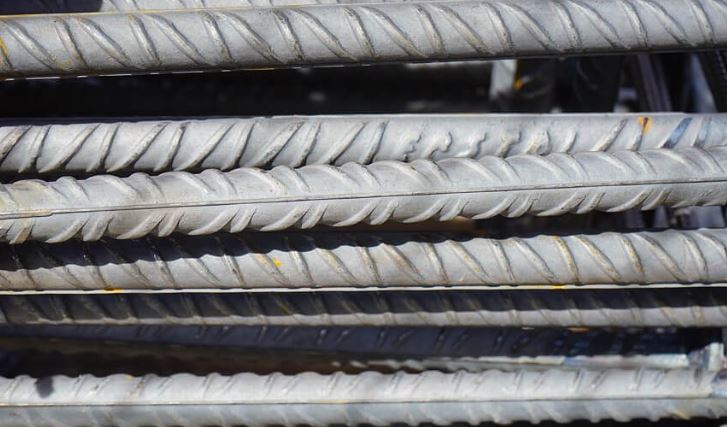


CTD bars are produced by twisting in cold condition. Higher strength and lower elongation and ribs improve the bonding with the concrete. Corrosion is an issue - so CTD bars are no longer use due to poor corrosion resistance. Available in dia of 6, 8 10, 12, 16, 20, 25, 28, 32, 36, 40 and 45mm. They are used in min concrete grade of M15.  

Thermo Mechanically Treated (TMT) or Quenched & Self-Tempered (QST) steel: 
After hot rolling to the desired size and shape, the low carbon steel bars are quenched with water and then cooled. Quenching (The act of extinguishing; causing to stop burning) converts the surface layer to (hard) martensite while the core remains as austenite (A solid solution of ferric carbide or carbon in iron; cools to form pearlite or martensite). As the bar cools, heat flows from the core to the surface layer turning it to tempered martensite (A solid solution of carbon in alpha-iron that is formed when steel is cooled so rapidly that the change from austenite to pearlite is suppressed; responsible for the hardness of quenched steel). The core transforms to ductile ferrite-pearlite.

Further to TMT bar, Corrosion Resistant Steel (CRS) TMT reinforcement has developed. Bars with small quantities of copper and chromium, and higher than usual percentage of phosphorus. i.e., Carbon – 0.15%, Manganese – 1%, Sulphur – 0.04%, Phosphorous – 0.10%, Silicon – 0.45%, Corrosion resistant elements – 0.50% (minimum).

Stainless steel reinforcement
Stainless steels are alloys that contain at least 12% of chromium. Other alloying elements such as nickel and molybdenum may also be present.Chromium oxide layer forms on the stainless steel surface to prevent corrosion. These steels offer good resistance to corrosion as long as the passive film can be maintained.

Prestressing steel reinforcement – wire strands / Threaded bar:
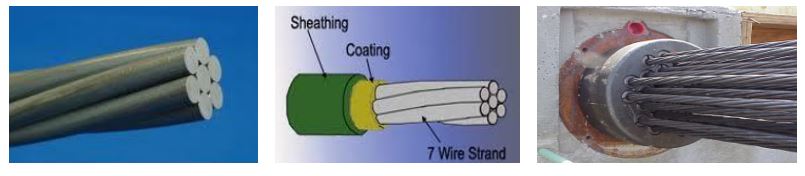
A high tensile alloy steel bar which features a coarse right-hand thread over its full length. Hot rolled, quenched and tempered, followed by cold working and further tempering, to achieve the necessary performance. 1000 hour stress relaxation is typically less than 3.5%.

Glass-Fiber-Reinforced-Polymer (GFRP)

GFRP is made up of carbon fibre. As it is made up of fibre, bending is not allowed. It is very resistant to corrosion and is costly when compared to other rebars. Now a days GRPF panels were also made both in cast-in-suit or pre-cast.


How to identify the bars at site level?

> The first letter or symbol identifies the producing mill.
> The next marking is the bar size.*
> The third marking symbol designates the type of reinforcing steel — usually either "S" for > carbon-steel (ASTM A615) or "W" for low-alloy steel (ASTM A706).
> Finally, there will be a grade marking (60, 75, 80, 100, 120) or by the addition of one line (60) or two lines (75), three lines (80, 100), or four lines (120) that must be at least five deformations long.

In other country:

Splicing Bar
Reinforcement bars comes in specified length. All RCC structure are constructed in monolithic manner and hence the reinforcement bars shall be in continuous so that they can transfer the load uniformally without break in between. Hence, bars needs to joined and the joining the bars is called as Splicing bar.

Grades:
The reinforcement steel bars used in RCC (Reinforced Cement Concrete) are known as Fe415 or Fe500. The numbers 415 and 500 is the Yield Strength in N/mm2.

As per IS:1786 - Yield Stress (also known as 0.2% proof stress).

Ex: Fe 500 is the reinforcement bars that can safely withstand a Yield Stress of 500 N/mm2 which is stronger than 415 N/mm2 by~20%.

Somethimes, we see Fe500D, here “D” represents ductility. and these bars are used at High-rise Buildings which needs more flexibility in building to avoid brittle failure.


Grades of Rebar in Different Codes:
American Standard (ASTM A 615)Euro Standard(DIN 488)British Standard BS4449: 1997Indian Standard (IS: 1786)
Grade 75 (520)BST 500 SGR 460 AGrade Fe – 415, Fe – 500, Fe – 500D
Grade 80 (550)BST 500 MGR 460 BGrade Fe – 550

Mild steel bars grade-I designated as Fe 410-S or Grade 60.
Mild steel bars grade-II designated as Fe-410-o or Grade 40.
Medium Tensile Steel Bars designated as Fe- 540-w-ht or Grade 75.

Corrosion-Resistance Bars
Corrosion of reinforcing steel may occur sue to the following reasons:
a. pH of the concrete is decreased from chemical attack or from reaction of the concrete with CO2 in the atmosphere.
b. Sufficient chloride ions reach the bar.-  from deicing salts or sea water.
If steel corrodes in concrete it may cause cracking or spalling of the concrete.

Hence, it is good to use bar with Improved Corrosion Resistance. Such as Stainless Steel Bars, Galvanized Steel Bars or Epoxy-Coated Reinforced Bars.

As per ASTM, bar designations with improved corrosion resistance over uncoated Bars as follows:
a. ASTM A767/A767M: Zinc-Coated (Galvanized) Steel Bars for Concrete Reinforcement
b. ASTM A775/A775M: for Epoxy-Coated Reinforcing Steel Bars
c. ASTM A934/A934M: Epoxy-Coated Prefabricated Steel Reinforcing Bars
d. ASTM A955/A995M: Deformed and Plain Stainless-Steel Bars for Concrete Reinforcement
e. ASTM A1035/A1035M: Deformed and Plain, Low-carbon, Chromium, Steel Bars for Concrete Reinforcement

But, we have saw many structure standing from 100 years made with normal steel - How?
When steel is placed into concrete of high pH value, it develops a passive oxide film. This passive film prevents further corrosion of the steel and there are many examples where common reinforcing steel in concrete has remained un-corroded for over 100 years.

Why to use TMT bars over HYSD and CTD/TOR steel:
1. Due to the ductile micro-structure and a hard crystalline exterior surface of TMT bars, TMT bars have a stronger external layer as compared to HYSD steel bars.
2. TMT bars have less residual stresses and higher tensile strength than HYSD bars because TMT bars do not undergo any physical deformation, unlike HYSD bars.
3. As TMT bars do not undergo any physical deformation (twisting), no torsional stress occurs which removes the chances of surface defects in TMT bars.
4. Due to the reduced amount of surface defects in TMT bars as compared to HYSD steel, they are comparatively much less susceptible to the harmful effects of oxidation like corrosion.
5. TMT bars do not require explicit hardening as the hardening process is conveniently achieved by the water quenching process, thus reducing the energy and expenditure required for physically deforming the steel bars, and hence increasing their affordability.
6. Due to the amazing flexibility and durability exhibited by TMT bars, they can be used for a wide range of construction works and is basically one of the primary reasons why construction workers rely a lot more on TMT bars as compared to HYSD steel bars.
7. Using TMT bars for construction helps to reduce the consumption of steel by 8% to 11% as compared to HYSD bars for the same construction, again increasing their affordability.
8. As TMT bars have a uniform and hardened periphery and a considerably softer core, this kind of bars will have the desired tensile strengths coupled with high elongation and ductility as required in the construction of buildings located in areas with regular seismic activity. 
9. TMT bars provide a longer life to the structures where they are used. The TMT steel inside the concrete does not react with the moisture in the surroundings. This reaction when allowed to occur results in the formation of rust which acts like cancer and results in cracks in the concrete, thus weakening the structure and subsequently shortening the lifespan of structures and buildings. 

Quantity surveying and steel in construction.

Cost Ratio (C.R.) for steel and concrete: 
The ratio between the cost of two parts or components involved in a work is known as Cost Ratio, shortly termed as C.R. Rate of steel per.cu.m. is taken as 62.5 times the cost of concrete as prevailing in India. 
So, cost ratio or C.R. for steel and concrete is Cost of steel per Cu.M / Cost of concrete per M = 62.5
Weight of 1 cu.m. steel (Tor or plain) = 7850 kg. Cost@8.40 per kg = Rs.65940
Cost of 1 cu.m. of concrete M15 (1:2:4) for R.C.C. work = Rs. 1050
Therefore, Cost Ratio for steel and concrete = Rs.65940/Rs.1050 = 62.8


Please note: Price of larger diameter bars is also lower than of smaller ones. The basic price is that of 16 mm bars, all larger bars being priced at this rate while smaller bars cost proportionately more for each 3 mm diameter below 16 mm. But this should be remembered that for cutting and bending, bars of 25 mm diameter and larger, oxy-acetylene flame or power operated machine may be used. Bars upto 8 m length can be easily transported and handled. Bars upto 10 mm diameter can be obtained in long lengths in coils.


Prof. BN Dutta, for estimating steel for different components of a building is provide with some thumb rules as follows (this may be used for pre-tending works not for execution work):
a. Footing - 0.8% of concrete
b. Beam - 2% of concrete
c. Column - 5% of concrete
d. Slab - 1% of concrete

How to read the steel section?
Parts of sections: 

Please see this video for more details: https://youtu.be/FjjSQ4yhC7o

Bar Bending Schedule:
Bar bending schedule commonly known as BBS is one of the most important term in Civil Engineering. Like other building materials like cement, brick, stones, tile, etc., estimation of steel is also required for constructing a building. Bar bending schedule provides the reinforcement calculation not only for the costing for quantity surveyors but also helps to bar bending works with important details such as bar mark, bar diameter, bar shape, cutting length, number of bars, the weight of bar, total weight of steel etc.Bar bending schedule (or schedule of bars) is a list of reinforcement bars for a given reinforced concrete work item, and is presented in a tabular with bars – diameter, shape of bending, length of each bent and straight portions, angles of bending, total length of each 
bar, and number of each type of bar.

How to read the bars drawing?

Definition of bars:
Main reinforcement bar
1. Main reinforcement bar is to provide at the shorter span direction.
2. Main reinforcement bars at the bottom of the slab for taking all the tensile stresses, bending moment (Sagging), and superimposed load (Dead load) which developed at the shorter span of the slabs.
3. Dia of the main reinforcement bars are higher.
4. In one way slab, the slab is supported at two parallel sides where main reinforcement will be placed parallel to the support.
4. In two way slabs, the span will be supported at four ends. So there won’t be any difference in bar size. Because each side will have to transfer the same amount of stress evenly.

Distribution bars
a. Distribution bars are used to resist the shear stress, cracks developed in the longer span.
b. Distribution bars perpendicularly on top of the main bars.
c. Lesser dia is used as it is only to resist the cracks developed due to shear stress on top of the slab.

Stirrups:
Stirrups will be required at areas of high shear, such as bearing points and below large point loads, to reduce the need for additional piers. The deeper the beam, the more shear capacity. When the depth is not adequate, steel stirrups must be added to increase the shear capacity of the beam.

Hook Length:
The hook is the extra length left at the 4th corner of a stirrup so that the stirrup retains its shape. Generally, hook length is taken as 9d for one side.

Stools:
Stools are used to separate the top reinforcement mesh and bottom reinforcement mesh using (in general) 12 mm or 16 mm bars. Dimension of the Stools could be change as requirement. Those should be strength enough to bear the loads without changing the gap of two layers. 

Different lengths:

Development length: Development length is the length of bar required for transferring the stress into concrete. The quantity of the rebar length that is actually required to be embedded into the concrete to create the desired bond strength between steel and concrete and furthermore to produce required stress for the steel in that area.
Development length (Ld) = d x σs/τbd
Where as,
d = Diameter of the bar.
σs = Stress in the bar at the section considered as design load
τbd = Design bond stress.


Lapping length:Lap length is the overlapping length of two bars side by side which gives required design length. In RCC structure if the length of a bar is not sufficiently available to make design length, lapping is done.
Suppose we need to build a 20 m tall building. But is there any 20 m bar available in the market? No, the maximum length of rebar is usually 10 / 12 / 12.5 m, so we need to join two bars to get 20m bar.
Lap length for tension members = 40d.
Lap length for compression members = 50d.

Crank length: Length of the bar at change in direction or bend length.

Anchor Length: Length of the bar extended in to the vertical member from the horizontal member for better holding. In the above drawing, Anchor length = 150- (Cover (i.e 25 mm)+ dia of bar 20mm = 145mm


BEND LENGTH:
The bar is bent at the column end to tie with the footings. This extra length for bend is called bend length. Bend length is generally considered as 16d
Bend Deduction Length Of Bar: The straight length of the bar is equal to the exact length of the bar. When we bend the bar, the length of the bar slightly increased due to stretching in the bending area. The expansion of length depends on the grade of steel and the degree of bend. The length increases with the increase of bending degree and decreases with the higher grade steel. Bend with different angle will have different expansion in length. Hence, to calculate the total length of the bar which has bends in it, we need to duct the expansion of the bar, this is called bend deduction length. Refer the below image:


CRANK LENGTH:
Generally, bars are bent near the support at an angle of 45°. The angle of bend may also be 30° in shallow beams. The purpose of bend near the support is firstly to resist the negative bending moment which occurs in the region of the support and secondly to resist the shear force which is greater at the support. Crank length = D/sin45° – D/tan45° =1.42D – D = 0.42D

UNIT WEIGHT OF STEEL:
The weight of bar is calculated by the following formula: W = d²L/162
Where W = Weight of bars.
L = Length of bars in meter.
d = Diameter of the bar in mm.
Example: Calculate the weight of 20 meters long 16 mm ø bar
W = 16² x 20/162 = 32 kg.


Let see the formula to find the reinforcement bars:
The following are based on "Indian Standard  - CODE OF PRACTICE FOR BENDING AND FIXING OF BARS FOR CONCRETE REINFORCEMENT - IS:2502-1963 (Reaffirmed 1990)'
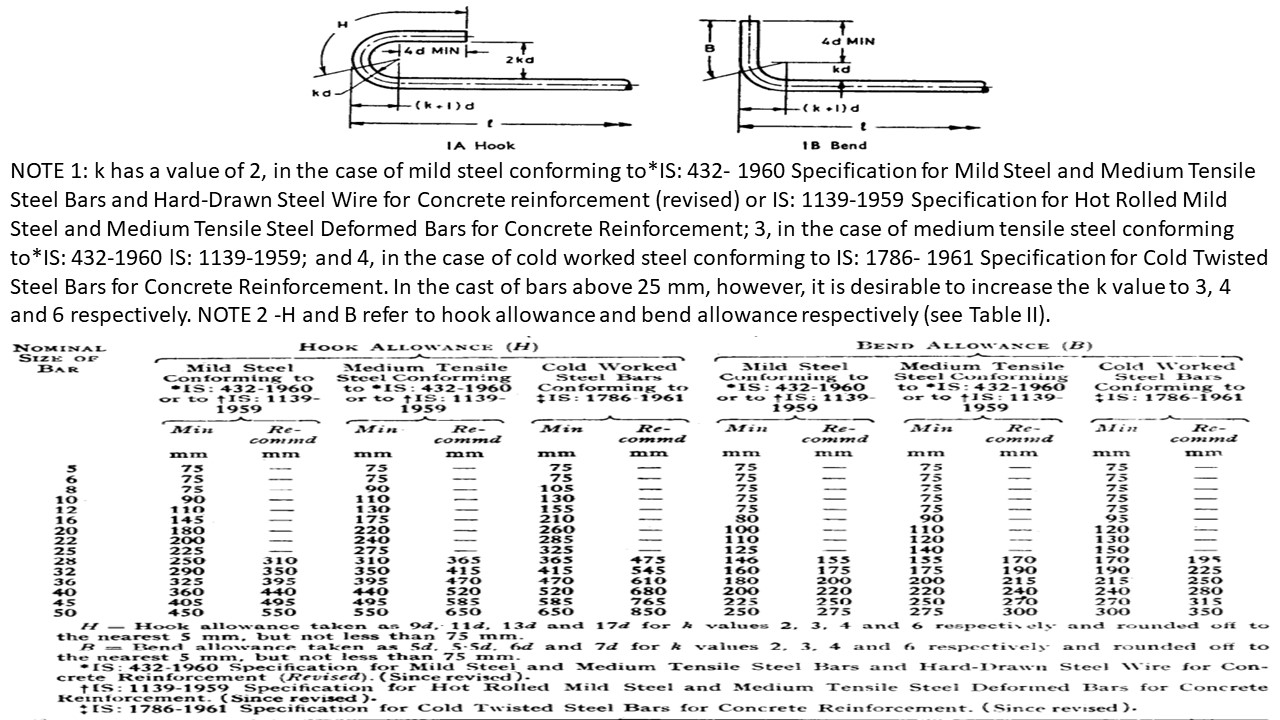


Download this ready to start the Bar Bending schedule: https://drive.google.com/file/d/1SlYk_exbdwIit8F1JIoHTew16CA40EFt/view?usp=sharing

Checklist for site engineer for reinforcement:
1. Structural Dwg. No. and date as per which reinforcement checked. Bar Bending Schedule Prepared?
2. Connecting of bars to existing dowels to be checked for alignment. OK?
3. Placing of Bar diameter, number, spacing match with the Construction Schedule?
4. Lap Length, Position of lap, OK?
5. Cleanliness of shuttering and Bars OK?
6. Chairs provided?
7. Cover for reinforcement ok?
8. Provision of cover blocks/ preparation of cover blocks.
9. Maintaining records and getting approval for additional reinforcement not shown.
10. To check the construction joint for proper concrete bonding before placing reinforcement.
11. Installed bars of required dia.
12. Check for Test Reports for steel and approved brand or not.
13. Check colour coding for identification.
14. Check for proper binding (double strand/quality of binding wire).
15. Check for any rework or alteration.

Many thanks to Google.com, Doc88.com, Indian Institute of Technology Madras, aonesteelgroup.com, Wordweb.com, crsi.org, from where the details were collected.

Wednesday, April 3, 2019

Upanishad

Upanishad means “sitting nearby’

These are the part of The Vedas, the unwritten Scripture of the Hindus, over 5000 (Five Thousand) years old and transmitted by oral tradition, that contains the enquiry into the Nature of the World :

a. Where were we?
b. Where we are?
c. Where do we go from here?

The following table explains which are the Upanishads and in which Veda does they belong to:
RIG (10)
Yajur (51)
Sama (16)
Athrava (31)
Krushna (32)
Shukla (19)
Aitare Upanishad
Kata Upanishad
Isavasya Upanishad
Kena Upanishad
Parasana Upanishad
Atma-Bodha Upanishad
Tattriya Upanishad
Brihandranayaka Upanishad
Chandogaya Upanishad
Mandukya Upanishad
Kaushitaki-Brahmana Upanishad
Akshi Upanishad
Adhyatama Upanishad
Maha Upanishad
Mundaka Upanishad
Mandgala Upanishad
Ekakshara Upanishad
Nirmalamba Upanishad
Maitrayani Upanishad
Atma Upanishad
Nirvana Upanishad
Garbha Upanishad
Paingala Upanishad
Vajrasuchika Upanishad
Surya Upanishad
Nada-Bindu Upanishad
Pranagnihotra Upanishad
Mantrika Upanishad
Savatri Upanishad
Narada Parivarajaka Upanishad
Aksha Malika Upanishad
Svetasvatara Upanishad
Mukithika Upanishad
Aruni Upanishad
Para Bharama Upanishad
Tripura Upanishad                            
Sariraka Upanishad
Subala Upanishad
Kundika Upanishad
Paramahamsa Parivarakaja Upanishad
Bahvircha Upanishad
Suka Rahaysa Upanishad
Jabala Upanishad
Matirayani Upanishad
Pushpa Bharaman Upanishad
Saubhagya Lakshmi Upanishad
Skanda Upanishad
Turiyatita Avadhuta Upanishad
Sannayasa Upanishad
Maha Vakya Upanishad

Sarva-Sara Upanishad
Paramahamsa Upanishad
Jabali Upanishad
Sandulya Upanishad

Katurarudra Upanishad
Bhishuka Upanishad
Yoga chudamani Upanishad
Krishna Upanishad

Brahama Upanishad
Yajnavalakya Upanishad
Avyakta Upanishad
Garuda Upanishad

Avaduta Upanishad
Satayayaniya Upanishad
Vasudeva Upanishad
Gopala Tapaniya Upanishad

Amrita-Nada Upanishld
Mandala Bharanam Upanishad
Rudraksha Jabala Upanishad
Tripadavibuti Mahanarayana Upanishad

Amrita-Bindu Upanishld
Trishiki Bhraman Upanishad

Dattaterya Upanishad

Kshurika Upanishad
Advaya Taraka Upanishad

Narashima Tapaniya Upanishad

Tejo bindu Upanishad
Hamsa Upanishad

Rama Tapaniya Upanishad

Dhayna Bindu Upanishad
Tara sara Upanishad

Rama Rahaysa Upanishad

Bhrama Vidya Upanishad


Hayagriva Upanishad

Yoga Kundalini Upanishad


Athravashika Upanishad

Yoga Tatvva Upanishad


Athravasiras Upanishad

Yoga Shika Upanishad


Ganapati Upanishad

Varaha Upanishad


Bhasma Jabala Upanishad

Kali santarana Upanishad


Sarabha Upanishad

Maha Narayana (Yajaniki) Upanishad


Brihad Jabala Upanishad

Kaligni Rudra Upanishad


Annapurna Upanishad

Kaivalya Upanishad


Tripura Tapani Upanishad

Dushinamurti Upanishad


Devi Upanishad

Pancha-Brahma Upanishad


Bhavana Upanishad

Rudra-Hridaya Upanishad


Sita Upanishad

Sarasvati-Rahasya Upanishad


To get Moksha, the Mandukya Upanishad is enough; 
If knowledge is not got from it, then study the Ten Upanishads. 
Getting knowledge very soon, you will reach my abode. 
If certainty is not got even then, study the 32 Upanishads and stop. 
If desiring Moksha without the body, read the 108 Upanishads.

These 108 Upnishads arranged by priority (The order as given in the Muktika Upanishad I-1-26-29), then the arrangement will be as follows:
1. Isa*
2. Kena*
3. Katha*
4. Prasna*
5. Munda*
6. Mandukya*
7. Taittiri*
8. Aitareya*
9. Chandogya*
10. Brihadaranyaka*
11. Brahma
12. Kaivalya
13. Jabala
14. Svetasva
15. Hamsa
16. Aruni
17. Garbha
18. Narayana
19. Paramahamsa
20. Amritabindu
21. Amritanada
22. Atahrvasirah
23. Atharvasikha
24. Maitrayini
25. Kaushitakibrahmana
26. Brihajjabala
27. Nrisimhatapini
28. Kalagnirudra
29. Maitreya
30. Subala
31. Kshurika
32. Mantrika
33. Sarvasara
34. Niralamba
35. Sukarahasya
36. Vajrasuchika
37. Tejobindu
38. Nadabindu
39. Dhyanabindu
40. Brahmavidya
41. Yogatattva
42. Atmabodha
43. Naradaparivrajaka
44. Trisikhi
45. Sita
46. Yogachudamani
47. Nirvana
48. Mandalabrahmana
49. Dakshinamurti
50. Sarabha
51. Skanda
52. Tripadvibhuti-Mahanarayana
53. Advayataraka
54. Ramarahasya
55. Ramatapani
56. Vasudeva
57. Mudgala
58. Sandilya
59. Paingala
60. Bhiksu
61. Mahat
62. Sariraka
63. Yogasikha
64. Turiyatita
65. Sannyasa
66. Paramahamsaparivrajaka
67. Akshamalika
68. Avyakta
69. Ekakshara
70. Annapurna
71. Surya
72. Akshi
73. Adhyatma
74. Kundika
75. Savitri
76. Atma
77. Pasupata
78. Parabrahma
79. Avadhutaka
80. Tripuratapini
81. Devi
82. Tripura
83. Katharudra
84. Bhavana
85. Rudrahridaya
86. Yoga-kundali
87. Bhasma
88. Rudraksha
89. Ganapati
90. Darsana
91. Tarasara
92. Mahavakya
93. Panchabrahma
94. Pranagnihotra
95. Gopalatapini
96. Krishna
97. Yajnavalkya
98. Varaha
99. Satyayani
100. Hayagriva
101. Dattatreya
102. Garuda
103. Kalisamtarana
104. Jabali
105. Saubhagyalakshmi
106. Sarasvatirahasya
107. Bahvricha
108. Muktika

I am trying to get the Audio of all Upanishad in Hindi language..........

Tuesday, April 2, 2019

Indian festival – Ambedkar Jayanthi

Bharat Ratna Dr. Bhimrao Ambedkar is known as a world-class lawyer, Dalit political leader and chief architect of the Indian Constitution.


Babasaheb, Dr. Bhimrao Ambedkar was born on 14th April 1891 in a poor untouchable family of Mhow and he died on 6th December 1956 in Delhi. 

Dr. Babasaheb Ambedkar's real surname was Ambawadekar. But his teacher, Mahadev Ambedkar, gave him Ambedkar surname in the school records.
Dr. Babasaheb Ambedkar was the first Indian to get a Doctorate (Ph.D.) degree in Economics from abroad. Babasaheb is the first and only person in the world to receive a valuable doctorate degree named "Doctor All Science" from the London School of Economics. Many intelligent students have tried for it, but they have not been successful until now.
Dr. Ambedkar is the only Indian whose statue is attached with Karl Marx in the London Museum.
The credit of giving place to "Ashok Chakra" in the Indian Tricolour also goes to Dr. Babasaheb Ambedkar.
Nobel Prize winner Prof. Amartya Sen considered Dr. B. R. Ambedkar as his father in economics.

For the better development of Madhya Pradesh and Bihar, Babasaheb had proposed division of these states in 50s, but only after 2000 Chhattisgarh and Jharkhand were formed by splitting Madhya Pradesh and Bihar. 

Babasaheb's personal library "Rajgirh" consisted of more than 50,000 books and it was the world's largest private library. 

The book "Waiting for a visa" written by Dr. Babasaheb is a textbook in Columbia University. Columbia University made a list of world's top 100 scholars in 2004 and the first name in that list was Dr. Bhimrao Ambedkar.
Dr. Babasaheb Ambedkar was master in 64 subjects. He had knowledge of 9 languages like Hindi, Pali, Sanskrit, English, French, German, Marathi, Persian and Gujarati. Apart from this, he studied all the religions of the world in comparative way for almost 21 years.
In the London School of Economics, Babasaheb completed 8 years of studies in just 2 years 3 months. For this, he studied 21 hours in a day.
Dr. Babasaheb Ambedkar's initiation in Buddhism with his 8,50,000 supporters historical in the world, because it was the largest conversion in the world. 
"Mahant Veer Chandramani", a great Buddhist monk who initiated Babasaheb to Buddhism, called him "the modern Buddha of this age".

In 1954, in the "World Buddhist Council" held in Kathmandu, Nepal, Buddhist monks had given Dr. Babasaheb Ambedkar highest title of Buddhism "Bodhisattva". His famous book "The Buddha and his Dhamma" is the "scripture" of Indian Buddhists.
Dr. Babasaheb Ambedkar had considered three great men, Lord Buddha, Saint Kabir, and Mahatma Phule as their "instructor".
Everywhere in the world, Buddha's closed-eyed statues and paintings are visible, but Babasaheb, who was also a good painter, made the first painting of Buddha in which Buddha's eyes were opened.
Worldwide, the highest number of songs and books written in the name of the leader is Dr. Babasaheb Ambedkar.
Governor Lord Linlithgow and Mahatma Gandhi believed that Babasaheb is more intelligent than 500 graduates and thousands of scholars.

Babasaheb was the world's first and only Satyagrahi, who did Satyagraha for drinking water.
The highest number of the statue in the world is of Babasaheb. His birth anniversary is also celebrated all over the world.
Babasaheb was the first lawyer from the backward class.
Based on a global survey called "The Makers of the Universe" a list of top 100 humanist people of the last 10 thousand years was made by Oxford University, in which the fourth name was Dr. Babasaheb Ambedkar.
Babasaheb Ambedkar has given many suggestions in the book "The Problem of Rupee-Its Origin & its solution" about the demonetization that is being discussed all around in the present time. He has described in his book that "If any country has to eliminate black money and fake currency, then after every 10 years Country's currency should be demonetized."
The first Statue of Babasaheb was built in the year 1950 when he was alive and this statue is established in Kolhapur city.
Ambedkar was the first Indian to pursue a doctorate in economics abroad. 

Ambedkar changed the working hours in India from 14 hours to 8 hours. 

Ambedkar had opposed Article 370 of the Indian constitution - (Ambedkar refused to draft Article 370 of the constitution (which gives special status to the state of Jammu & Kashmir) on the grounds that it was discriminatory and against the principles of unity and integrity of the nation. Article 370 was eventually drafted by Gopalswamy Ayyangar, former Diwan to Maharajah Hari Singh of Jammu and Kashmir.)

Ambedkar played a key role in establishment of Reserve Bank of India in 1935.

Many thanks for reading.........

Thursday, March 21, 2019

OSMOSIS


In a few cases severe blistering of thin synthetic resin floorings occurs between 3 months and two years after laying.  These blisters commonly vary in size from a few mm in diameter up to 100 mm, with heights up to 15 mm.  When drilled into or otherwise broken the blisters are found to contain an aqueous liquid under very high pressure.  The mechanism of their formation is not fully understood but it is assumed because of their physical state that they are caused by a process of osmosis.  Blistering which occurs soon after the flooring is installed is unlikely to be caused by osmosis and is more likely to result from water contained in the structure. 
Osmotic blisters only occur with thinner synthetic resin floorings, resin coatings and flow applied systems, up to about 6 mm in thickness.  The problem has not been observed with trowel applied resin floorings probably because of their higher resistance to deformation and greater lateral permeability. 
..............................Please refer to FeRFA Guidance Note No 2: Osmosis in Resin Flooring ISBN 0 9538020 5 1

Because the mechanism is not fully understood it is not possible to be specific about the steps which should be taken to avoid osmotic blistering.  However it is considered good practice to take the following steps in order to minimise the risk.
a) In new construction ensure the base concrete has low soluble salts by avoiding poorly washed aggregates and by curing the concrete well immediately after laying to prevent premature surface drying out; 
b) Allow the concrete to dry out thoroughly after curing, preferably for a minimum of 21 days. 
c) By the use of mechanical rather than chemical means of preparing the concrete surface.  In particular by avoiding the use of acid etching; 
d) By avoiding washing the concrete surface with detergent solutions as part of the preparation procedure.
e) By the complete removal of all contamination from existing floors:  this may prove very difficult where the concrete has been saturated for long periods with water soluble materials.
f) Any levelling screeds should preferably be polymer-modified to minimise permeability and salt migration.
g) By the use of water vapour permeable floorings.
h) By the use of solvent-free primers rather than water-borne systems, under impervious resin floorings.
j) By ensuring that the synthetic resin flooring is precisely proportioned, either by weight or volume as specified by the product manufacturer. 

Where osmosis has occurred, techniques which have proved successful in preventing the problem reappearing, after cutting out the affected area and mechanically cleaning the exposed concrete, include: 
a) Double application of a penetrating primer to the base to ensure complete coverage and
maximum adhesion of the replaced flooring.
b) Replacing with a trowel applied flooring at a thickness of at least 6 mm; 
c) Hot compressed air blasting of the exposed concrete coupled with the application of a
penetrating primer whilst the concrete is still warm. 
d) By the use of water vapour permeable floorings.

Many thanks to Google.com, FeRFA, Doc88.com from where the details were taken.

Saturday, March 16, 2019

IS 15477 : 2019 – Tile adhesive testing standard

Adhesives have been classified into five types namely, Type 1, Type 2, Type 3, Type 4 and Type 5 based on Tensile adhesion strength and Shear adhesion strength and of course in consideration of type of tile/stone to be installed along with the substrate nature and situation.

Type 1 Adhesive: This adhesive is suitable mainly for tiles with apparent porosity greater than 3 percent. It is suitable for most of the clay and ceramic (non-vitrified) tiles of small dimension (size not more than 300 mm x 300 mm) and the majority of cement based backgrounds (substrates) like cement plaster, cement concrete, cement screed, etc, and for interior dry area applications only. Below values are in N/mm^2


Type 2 Adhesive: This adhesive is suitable mainly for tiles with an apparent porosity less than or equal to 3 percent. It is suitable for vitrified/fully vitrified tiles, glass mosaic tiles, all stones, dense and large dimension (More than 300 mm × 300 mm size) tiles and stones (slabs), and where background and location is more demanding like wet areas, submerged areas, etc. This type of adhesive is recommended for both interior floor and wall applications, and for exterior floor applications. Below values are in N/mm^2


Type 3 Adhesive: This adhesive is suitable mainly for tiles and stone tiles on exterior wall substrates like plaster or concrete. It is suitable for tiles like ceramic, clay tiles, basalt tiles, vitrified, glass mosaic tiles and porcelain tiles and all natural stone tiles. Below values are in N/mm^2


Type 4 Adhesive: This adhesive is suitable mainly for tiles and stone tiles which are included in Type 1, Type 2 and Type 3 (except metal tiles or engineered stones) but intended for installation on dry wall board substrates like gypsum boards, plywood, wood, calcium silicate boards, medium density fibre boards, fiber cement boards, cement boards, bison panel, etc. For all tiles/stones of size more than 600 mm × 600 mm, the adhesive shall also comply with ‘S1’ category of transverse deformation. For all tiles/stones of size more than 1200 mm × 1200 mm, the adhesive shall also comply with ‘S2’ category of transverse deformation.

These polymer modified adhesive can be achieved by the addition of a liquid admixture to the standard general purpose adhesive which is called as polymer fortified adhesive. Below values are in N/mm^2


Type 5 Adhesive: This adhesive is suitable for all types of tiles including engineered stones (manufactured stones) which are intended for installation on glass or metallic substrates like, grid iron, mild steel, stainless steel, aluminium or copper, etc. It is suitable for metal tiles, glass tiles, engineered stones or for all types of tiles and stones to be installed on different cement based substrates like cement screeds, plaster, concrete, drywall boards like gypsum boards, plywood, wood, metals composite boards, modified backer boards and the metallic substrates. Below values are in N/mm^2

These adhesive is generally a mixture of synthetic resin, mineral fillers and organic additives in which hardening occurs by chemical reaction. They are available in one or more component forms and in essence, these cover polyurethane adhesive, epoxy adhesives, Furane based adhesive, etc.


Along with this, some other test has to be performed and declared accordingly. Like:

      a.       Annex C, the open time shall not be less than that stated by the manufacturer.

      b.       Annex D, the adjustment time shall not be less than that stated by the manufacturer.

     c.       Annex E, the slip shall not be more than 0.5 mm. Slip resistant adhesives shall be                  designated as ‘T’.

     d.       Annex F, the deformability shall be within the range mentioned below for a particular class as stated by the manufacturer:

                                 I.            Deformable adhesive, S1 : > 2.5 mm, <5.0 mm

                               II.            Highly deformable adhesive, S2 : >5.0mm


Thanks for visiting blog.


TA - 1T

SS - 1T

GS - 2T - C1T

DS(G/W) - 3T - C2TS1

PSW - 4T - C2TES1

Afs1 (G/W) - 4TS1 - C2TES1

Afs2 - 4TS2 - C2TES2

EG - IS 4832

FR - IS 4832

Flex - __ - C2ES2 

WA91 - 

Friday, March 1, 2019

Determination of transverse deformation for cementitious adhesives and grouts


The test explained here is as per BS EN 12004 and BS EN 12002, and as follows:

1. Standard conditions shall be (23 ± 2)°C and (50 ± 5)% R.H. and air velocity in the working area of less than 0,2 m/s

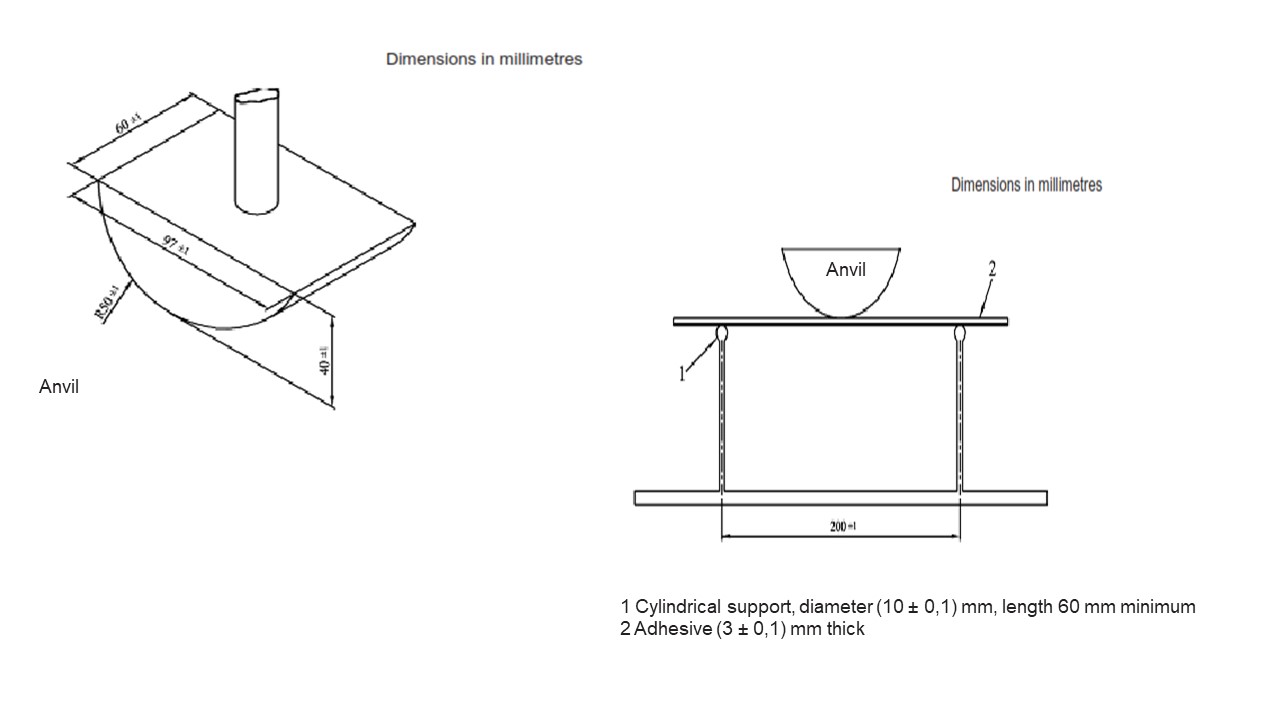
2. Place the plastic sheet and apply adhesive in the template of 280 X 45 X 5mm and compact the adhesive by placing in flow table and then get the sample adhesive using Template B of 300 X 45 X 3mm. After 48 Hrs, remove the template.

3. Condition the test units at (23 ± 2)°C. After 12 days remove them from the plastic container and condition them for 14 days in air in standard conditions.

4. Remove the specimens from the polyethylene film and measure their thickness at the middle and (50 ± 1) mm from each end. If the three values fall within the required tolerance of (3,0 ± 0,1) mm calculate the average value; discard any specimen which falls outside the required permissible thickness.

5. Place the test specimen on the test jig, deform it with a transverse load applied by the anvil at a rate of 2 mm/min until failure occurs. Record the deformation in millimetres. When no cracking occurs, report the maximum force and deformation.


6. The transverse deformation is determined to 0,1 mm, by calculating the average value of the deformations obtained in the test.


Click on words to read content:

(TWIs) (1) & Method B (1) 1 Gauge = mm (1) 1015-3 (1) 25mm per hour (1) 291 (1) 3D table in excel (1) 5 September (1) 5893 (1) 9900240603 (1) A 137.1 (1) A118.8 (1) AAC block adhesive (1) AAC block masonry (1) AASHTO T 277 (1) AASHTO T22 (1) Abrasion resistance (1) abrasion resistant (1) absorption test (1) ACE (1) ACI (1) ACI 212.3R (1) ACI 224 (1) ACI 302.1 (1) ACI 504R (1) ACI 515.1 (1) ACID ETCHED (1) Acrylic elastomeric coatings (1) Additive (1) Adhesion retention strength (1) Adhesion Field Test for sealant (1) adhesion of the adhesives (1) Adhesion test (1) adjustable time (3) Administration of shivaji (1) Advantage of using Notch Trowel (1) AGAINST GRAVITY TILE & STONE INSTALLATION (1) Agglomerated stones (1) AISC’s Steel design guide (1) Akshata Scribe (1) ALKALI SILICA REACTION (ASR) (1) All ASTM standards (1) All EN standards (1) All IS standards (1) All ISO standards (1) Ananthapadmanabha Swamy (1) Anchor plates (1) Anchoring (1) anchoring groove (1) ANIS A 118.10 (1) Anjali J - blog (1) Ank vidhya (1) annayya.chandrashekar (1) annayya.chandrashekar@gmail.com (1) annayyachandrashekar.blogspot.com (3) Ansi 118 requirement table (1) ANSI 118. IS 15477 Almost similar to BS 5980 (1) ANSI 118.10 (1) ANSI A118.3 (1) ANSI B 101.1 (1) ANSI tile adhesive (1) API RP 686 (1) Application videos (1) ARDEX ENDURA (2) AS / NZS 1327 (1) AS 1145 (1) AS 1580.405.1 (1) AS 2358 (1) AS 3706 (1) AS 3749: 2004 (1) AS 3958 (1) AS 3958.1 - surface tolerance (1) As exposed waterproofing for non-accessible roofs (1) AS/NZS 4586:1999 (1) AS39581.1-2007 (1) ASHRAE (1) Astha (1) ASTM 1305 (1) ASTM 2594 (1) ASTM A 36 (1) ASTM A 36M (1) ASTM A307-02 (1) ASTM B 117 (1) ASTM C 1107 (1) ASTM C 1107-02 (1) ASTM C 1193 (1) ASTM C 1202 (1) ASTM C 13155 (1) ASTM C 138 (1) ASTM C 1386 (1) ASTM C 1660 (1) ASTM C 1760 (1) ASTM C 198-01 (1) ASTM C 231 (1) ASTM C 386 (1) ASTM C 490 (1) ASTM C 531 (2) ASTM C 579 (1) ASTM C 617 (1) ASTM C 679 (1) ASTM C 827 (2) ASTM C 836 (1) ASTM C 882 (1) ASTM C 957 / 1127 (1) ASTM C-39 (1) ASTM C-531 (1) ASTM C109 (1) ASTM C109/C109M (1) ASTM C1107 (1) ASTM C117-17 (1) ASTM C1202 (1) ASTM C1242 (1) ASTM C1437 (1) ASTM C1521 (1) ASTM C1567 / ASTM C1698 (1) ASTM C1611 (1) ASTM C187-191 (1) ASTM C267-1982 (1) ASTM C270 (1) ASTM C307-03 (1) ASTM C3094 (1) ASTM C469 - 94 (1) ASTM C472-99. Setting time (1) ASTM C580 (1) ASTM C827 / C827M - 16 (1) ASTM C881 (1) ASTM C920 (1) ASTM C932 (1) ASTM D 1000 (1) ASTM D 1171 (1) ASTM D 1186 (1) ASTM D 1212 (1) ASTM D 1415 (1) ASTM D 1475 (1) ASTM D 1640 (1) ASTM D 1653 (1) ASTM D 1709 / ISO 7765 Method A (1) ASTM D 1876 (1) ASTM D 2240 (1) ASTM D 2471 (1) ASTM D 2697 (1) ASTM D 2794 (1) ASTM D 3278 (1) ASTM D 3359 (1) ASTM D 3363 (1) ASTM D 374 (1) ASTM D 4366 (1) ASTM D 4414 (1) ASTM D 4587 (1) ASTM D 471 (1) ASTM D 522 (1) ASTM D 523 (2) ASTM D 5276 (1) ASTM D 5385: 93 (1) ASTM D 5635-04a (1) ASTM D 6195 (1) ASTM D 624 (1) ASTM D 645 (1) ASTM D 6878 – 03 (1) ASTM D 695 (1) ASTM D 792 (1) ASTM D 823 (1) ASTM D 882 (1) ASTM D 903 (1) ASTM D-4060 (1) ASTM D1004 (1) ASTM D1149 (1) ASTM D149 (1) ASTM D1883 (1) ASTM D2487 (1) ASTM D2488 (1) ASTM D2584 (1) ASTM D297 (1) ASTM D2979 (1) ASTM D3420 (1) ASTM D3787 (1) ASTM D4400 (1) ASTM D4541 (1) ASTM D5630 (1) ASTM D5957-98 (1) ASTM D6241 (1) ASTM D638 (1) ASTM D751 (1) ASTM D903 (1) ASTM E 1155–96 (1) ASTM E 488 (1) ASTM E 96 (1) ASTM E11 (1) ASTM E119 (1) ASTM E303-93 (1) ASTM E399 - 12e3 (1) ASTM F 1147-05 (1) ASTM F 150 (1) ASTM F3191 (1) ASTM F710 (1) ASTM G14 (1) ASTM G154 (1) Astrology (1) astrology excel calculation (1) AutoCAD (1) AUTOIGNITION TEMPERATURE (1) B 101.3 (1) B 30 (1) Back Buttering (1) Balconies (1) Bar Bending Schedule (1) Basalt Stone in Construction (1) Base plate (2) basement Waterproofing (1) Battel of Shivaji (1) Bava Singificator (1) Beams (1) Beams & Columns (3) beans (1) Below-Grade Waterproofing - Performance Test (1) bending test (1) Bentonite waterproofing (1) BHE Façade Specifications (1) blind or vision impaired persons (1) Bond Strength (4) Bonding agent (1) bonding agent for gypsum plaster (1) BRE screed test (1) BRE test (3) Breaking strength of coating/membrane (1) Brick masonry (1) British standards 5295 (1) BS 1881 – Part 122 (1) BS 1881:105 (1) BS 3712 (1) BS 3900 E5 (1) BS 4254 (1) BS 4550 (1) BS 476 (1) BS 476 / 6 & 7 (1) BS 5212 (1) BS 5215 (1) BS 5889 (1) BS 5980:1980 (1) BS 6077 Pt 1 (1) BS 6093 (1) BS 6319 (2) BS 6319:7 (1) BS 6920 (1) BS 7044 (1) BS 7188 (1) BS 7542 (1) BS 7976-2 (1) BS 8102 (1) BS 812 Pt. 114 (1) BS 8204 (3) BS 829 (1) BS EN 1015 (1) BS EN 1062-1 (2) BS EN 12004 (5) BS EN 12004 Almost similar to ISO 13007 (1) BS EN 12350-5 (1) BS EN 12808-3 (1) BS EN 12808-4 (1) BS EN 1308 (1) BS EN 1372 (1) BS EN 13813 (2) BS EN 13888 and IS 4832 and IS 4443 (1) BS EN 13888. (1) BS EN 13892-2 (1) BS EN 13892-3 (1) BS EN 13892-4 (1) BS EN 13892-4 - BCA (1) BS EN 14235 (1) BS EN 14617-1 (1) BS EN 1504 full (1) BS EN 1504-3 (1) BS EN 1504: Part 3 (1) BS EN 2050 (1) BS EN 5385 Part 1 and Part 2 (1) BS EN 8204-2 (1) BS ISO 2878 (1) BS903 Part A26 (1) Bubble Deck (1) building back filling (1) Building foundation (1) Building parts (1) Bulk Modulus (1) C 920 (1) C-Value (1) C1305M-16 (1) C1621 (1) C20 (1) C230 (1) C881M (1) Calculation of BMI (1) calculation of grout (1) Calculator (1) Carbon dioxide permeability (1) CARBONATION (1) CBR test (1) CC floor (1) Cement (1) Cement Mortar (1) Cement mortar material calculation (1) cement quantity for concrete as per standards (1) cement quantity for plastering (1) Cement test in site (1) Cementitious grout (2) Chemical resistance and stain resistance test (1) Chemical resistance test (2) chemical resistant (1) chemical resistant grout (1) Chemical resistant mortar (1) Chemical-Resistant Mortars (1) chemicals (1) chequered plates (1) Chinese Magic Square (1) Chloride ion content test (1) chlorination of pool (1) Civil engineering (1) Civil engineering chandra Aoo (1) civil engineering notes (1) civil engineering related softwares (1) Civil engineering software (1) Civil engineers (1) Civil Services Day (1) class A (1) Class R4 mortar (1) clay tile (1) Cleaners (1) Cleanroom Technology (1) coating (1) coating test (1) Coefficient of thermal expansion (1) Coffieient of Thermal Expansion (1) Coin hit test (1) cold (1) Cold Liquid-Applied Elastomeric Waterproofing Membrane With Integral Wearing Surface (1) cold liquid-applied elastomeric-type membrane (1) Column Shoes and Anchor Bolts (1) Columns (2) Comments in Word (1) Common doubts in Flooring (1) Common doubts in Tiling doubts (1) Common doubts in Waterproofing doubts (1) Comparison between cementitious Vs epoxy tile joint grout (1) comparisons of product of waterproofing (1) Compatibility Check test (1) compression strength Vs time (1) compressive of tile joint grout (1) Compressive strength (2) Compressive strength for year (1) compressive strength of tile adhesive (1) Concrete (3) Concrete admixture (3) Concrete bonding agent (1) Concrete calculation (1) Concrete Compression test (1) Concrete repair standards (1) concrete subjected to fire or higher temperature (1) CONCRETE UNIT MASONRY (1) Conductive flooring (1) CONSISTENCY TEST (1) CONSTRUCTION (1) Construction chemical list (1) construction chemicals (2) construction sealant (1) Construction Specification (1) Construction standards (1) CORROSION (1) Corrosion Cracks (1) cost comparison (1) Cost Ratio (C.R.) (1) Cover blocks (1) coving application (1) CRA (1) CRA MTO App (1) CRA products (1) Crack bridging test (3) Cracking in an Ozone Controlled Environment (1) Cracks treatment (1) CRD-C 621-93 specifications (1) CRM (1) cross cut (1) CRYSTALLINE COATING TECHNOLOGY (1) CSA A23.1 (1) CSI format (1) CSP SURFACE (1) CTSD (1) Cube size for compressive strength (1) CURING (1) Cuspule singnificator (1) CYLINDRICAL BEND TEST (1) D 5898 – 96 (1) D1709 and D4272 (1) D635 (1) Dairy flooring (1) Dairy industries (1) Davangere (1) DEGREASER (1) Demotivated - Management (1) Determination of expansion of concrete (1) Determination of shrinkage (1) Determination of wear resistance — Böhme (1) Determination of wear resistance-BCA (1) DFT (2) Dheenoddhara trust for the disabled (1) Di-electric strength of material (1) Dielectric (1) difference (1) Difference between CG & RG grouts (1) different paint finishes (1) different type of curing (1) different types of stress (1) DIGITAL LAND SURVEYING AND MAPPING (1) DIN / ISO 6272-2 (1) DIN 1164 (1) DIN 1168 (1) DIN 18515 (1) DIN 18516 (1) DIN 18560 (3) DIN 4102-1 (1) DIN 51220 (1) DIN 52617 (1) DIN 53 217 (1) DIN 53157 (1) DIN 53519 (1) DIN ISO 48 (1) direction for sleep (1) dis-advantage of tensile testing (1) disadvantages of cladding (1) dissipative flooring (1) DKS 2129:2008 (1) Dr APJ Abdul Kalam (1) Dr. Bhimrao Ambedkar (1) Dr. Sarvepalli Radhakrishnan (1) DRR Govt Polytechnic (2) DRR SChool (2) dry film gauge (2) Dry Film Thickness. (1) Dry Hard Time (1) Dry Recoat time (1) Dry To Handle Time (1) Dry-Through Time (1) Dust Free Times (1) E 135 (1) EARTH SUMMIT (1) easy typing (1) EC@ (1) EC1 (1) EC1plus (1) EC2 (1) Effects of Rapid Deformation (Impact) (1) Efflorescence - causes (1) Efflorescence test (1) Elastic Modulus (1) elasticity test (1) Elcometer (1) electric resistivity (1) Elongation retention strength (1) elongation test (1) email client (1) Emicode (1) EMS (1) EN 1015-11 (1) EN 10204:2004 (1) EN 1062 (1) EN 1097-8:2009 (1) EN 12004 (1) EN 12350-12 (1) EN 12350-9 (1) EN 13036-4:2003 (1) EN 1348 (2) EN 13501-1 (1) EN 13813 (3) EN 13888 (1) EN 1436 : 1997 (1) EN 14891 : 2017 (1) EN 1504-2 (1) EN 196 (2) EN 459-2 (1) EN 480-2 (1) EN ISO 2813 (2) EN ISO 7500-1 (1) EN-934 (1) ENGINEERING (1) Environmental Management System (1) EP 305 (1) EPC Contract (1) Epoxy (3) epoxy adhesive for expansion joints (1) Epoxy and polyurethane flooring (1) Epoxy and PU flooring & coatings (1) Epoxy bonding agent (1) Epoxy flooring (2) Epoxy flooring as per IS STandard (1) Epoxy grout (2) epoxy injection grouting (1) Epoxy primer for PU (1) EPOXY PRODUCTS IN RELATION TO FIRE (1) Epoxy-Resin-Base Bonding Systems (1) ESD floor (1) Estimation and costing (1) excel trick (1) Expansion joint (1) Expansion joint treatment. epoxy adhesive (1) Expansion joints (1) Exterior Stone Cladding Requirements (1) external and internal cladding (1) external fire exposure to roofs (1) Falling Dart Impact Tester (1) FC SS (1) Federal standard 209 (1) fiber mesh (1) find compression strength (1) Fine bed (1) FINENESS TEST (1) FIRE POINT (1) Flash point (1) flexibility test (1) Flexible adhesive (1) Flexural and compression strength in one set (1) Flexural Cracks (1) Flexural strength (1) flexural strength of tile joint grout (1) Flood test (1) Floor adhesive (1) Floor flatness (1) floor hardeners (1) Floor maintenance (1) floor metallic floor hardeners (1) Floor slabs (2) Floor treatment (1) Flooring (5) Flooring & coating (1) Flooring MTO App (1) Flow Time Measurement (1) Food grade certification (1) Food grade epoxy flooring (1) Formula for BMI (1) foundations (1) Four-Step Theory for prediction (1) FREEZING – THAWING (1) FRP Pools (1) full strength concrete (1) Furane based mortar (1) GCC Standardization Organization (1) Gel Time test (1) Geosynthetic mat (1) Geotextile (3) GEV (1) Gloss (2) gloss meter (2) Gmail (1) gmail to outlook (1) Good sand (1) GPS surveying (1) grade 1 (1) Grades of Rebar (1) great civil engineering structure (1) Green building - USGBC - GRIHA - LEED - IGBC (1) GRINDING (1) groove (1) grout (1) Grouting (1) GSO ISO 13007-1:2012 (1) GSO tile adhesive standard (1) GUARANTEES (1) guidlines (1) Hanger (1) Hanger flooring (1) HDPE (2) heat (1) HIGH PRESSURE WATER & BLASTING & JETTING (1) High strength concrete (1) High-Solids Content (1) Hindu vedas (1) HMHDPE (1) hollow sound (1) hollow sound in stones (1) hollow sound in tile (1) HOMOGENEOUS and HETEROGENEOUS (1) House significations (1) how to calculate Challenge Number (1) How to fill water in pools (1) How to find out BMI (1) How to find out coating coverage from solid content and WFT? SI 101 (1) How to make 3D table (1) HR Rated ASTM E119 (1) humidity (1) Hydraulic Cement cube (1) Hydro static pressure resistant coating (1) hydro-static pressure (1) Hydro-static pressure test of membranes (1) Hydrophilic (1) Hydrophobic (1) Hydrostatic pressure test of membranes (1) Hygroscopic (1) IAS (1) Idioms (1) IEC (1) IEC 60243 (1) India Language (1) Indian festival (1) Indian festival - Republic Day (1) Indian leaders (1) Indian Standards (1) Industrial flooring (2) industrial grade tiles (1) Integral waterproofing (1) inter-locking clay tiles (1) International Hardness (1) interval for expansion joints (1) interview tips (1) Inverted Probe Machine (1) IPS (1) IRC: SP-20 (1) IRHD compact test (1) IS 101 (2) IS 101 : Part 5 : Sec 2 (1) IS 101 : Part 8 : Sec 3 (1) IS 101 P5 S2. (1) IS 10889 (1) IS 11600 (1) IS 1237 (2) IS 13311 part 1 & 2 (1) IS 13630 (1) IS 13630 (Part 8) (1) IS 15058 (1) IS 15477 (6) IS 15477 : 2019 (1) IS 15489 (2) IS 2185 Part 3 (1) IS 2250 (2) IS 2547-1 (1) IS 2645 (3) IS 3025 (1) IS 3370 (1) IS 3495 (Part 3) (1) IS 383 (1) IS 4082 (1) IS 4101 Part 3 (1) IS 456 (1) IS 4631 (1) IS 4832 (5) IS 4971 (1) IS 516 (1) IS 5816 (1) IS 6041 (1) IS 6494 (2) IS 6925 (1) IS 7193 (1) IS 9103 (2) IS 9197 (1) IS 9862 (1) Is there any standard for waterstop? (1) IS: 4031 (Part 1) - 199 (1) IS: 4031 (Part 4) (1) IS: 456-1964 (1) ISO 10474:2013 (1) ISO 1183-1 (1) ISO 12236 (1) ISO 13007 (3) ISO 14001 (1) ISO 14001:2015(E) (1) ISO 1431-1 (1) ISO 1519:2011 (1) ISO 1522 (1) ISO 18123 (1) ISO 23599 (1) ISO 2811 (1) ISO 3451 (1) ISO 4624 (1) ISO 527 (1) ISO 9001:2015(E) (1) ISO 9227 (1) ISO 9703-1 (1) ISO 9703-2 (1) ISO 9703-3 (1) ISO audit (1) ISO standards (1) ISO/IEC 2602 (1) JC-T 985-2005 for SLC (Self Levelling Compound) (1) JIS K 6253 (1) JISK 6301 (1) joints grout (1) K-Value (1) Kannada - Popular Proverbs (1) KENYA tile adhesive STANDARD (1) KIc of Metallic Materials test (1) KINDLING POINT (1) Know always: What which why where when and how? (1) KP Astrology (2) LAB test (1) Landscaping (1) Lap width (1) Large format stones (1) laser leveling (1) Lead content (2) Lean concrete (1) level surveying (1) levelling of floor (1) Life of shivaji (1) Life story of great leader (1) Linear-Elastic Plane test (1) LIPPAGE (1) Liquid and powder Floor hardener (1) liquid applied (1) Liquid applied waterproofing - FAQ/MCQ (1) list of 108 upanishad (1) List of abbreviations for common polymers (1) List of full form for common polymers (1) litmus (1) Lo Shu Grid Numerology Calculator (1) look (1) Loop in / Loop out membrane (1) Loop Tack test (1) Low viscous epoxy (1) lustre (2) M sand (1) M15 (1) Main & distribution bar (1) Management - Teachings of Bahagavad Gita (1) Management - Teachings of Bahagavad Gita (1) mandrel (1) Materials Finer than 75-μm (1) maximum moisture content (1) Meaning of sand (1) MECHANICAL METHODS (1) MED Modules B and D (1) Membrane crack bridging (1) membrane requirements. (1) membranes (1) Mesh size to micron (1) Metallic chain beat test (1) Minimum moisture content (1) mixed density (1) MMHDPE (1) MODULUS OF ELASTIC (1) MOH'S scale (1) moisture (1) Moisture in floor (1) Moisture test (1) mort (2) MORT&H CI.1761.5 (2) mortar (1) mortar material calculation (1) Mortar to be used to bond the AAC shall have less or more compression strength? (2) most referred standards (1) MPI standards (2) MS word (2) MTO for concrete (1) NCCA II-12 (1) negative coating (1) NF P92 507 (1) NF T30-016 (1) NFPA285 (1) NFT 46-003 (1) No crack concrete (1) Nobel Laureate Rabindranath Tagore (1) non-metallic floor hardenrs (1) non-porosity (1) Non-woven cloth (3) Normal Plastering (1) notch trowel for tile adhesive (1) NSI & MIA (1) Numerology (1) Numerology - Challenge Number (1) Numerology - KUA Number / Angle Number (1) Numerology calculations (1) Numerology Calculator for free (1) Numeroscope (1) occult science (1) Occupational Health / Safety management and System (1) Ohms (1) OHSAS 18001 (1) OHT (1) On site tests (1) On-site test (1) On-site testing of cement (1) open time (3) Ordinary concrete (1) Osmosis (1) Osmosis problem (1) Outlook (1) overhead water tanks (1) Package Drop Tester (1) packaging test (1) paperboard (1) Particle density (1) passing ability (1) paver blocks (1) Peel adhesion test (1) Peel Strength Testing of Adhesive Bonds (1) Peel test (1) Pencil Hardness Test (1) Pendulum Impact Resistance (1) Pendulum test (1) Permeability retention strength (1) Permeance retention strength (1) PH course (1) pH test on concrete (1) pH-test (1) Pharmaceutical clean room classified (1) Phd Course (1) Phrases (1) Phrases and Idioms (1) Pile (1) Pipes in waterproofing (1) Pit sand (1) Plaster (1) Plastering material calculation (1) plastics and other resin materials (1) Pneumatic Bursting Tester for membranes (1) POD (1) Poineers (1) Poisson's Ratio (1) Poisson's Ratio of Concrete (1) Polystyrene grout (1) Polyurethane flooring (1) PolyVinylActate (PVAC) (1) Pond test (1) ponding (1) pool balancing (1) Pool filling and dewatering (1) porosity (1) porosity test (1) POSI TEST PULL-OFF (1) positive coating (1) Pot life test (1) PRAH (1) PRAN (1) Precast (1) predication (1) PreFab (1) President of India (1) Pressure grouting (1) Pressure-Sensitive Tack test of Adhesives (1) Problems in resin flooring and coatings (1) process of chemical injection (1) Process of constructions (1) process of pressure grouting (1) products test (1) PU (1) PU foam (1) PU Sealant. Problems in sealant (1) Pull-Off (1) pure polyurea (1) PVA (Poly Vinyl Acetate) (1) PVC (1) pyramid (1) quantity calculations (2) R-Value (1) R3 Mortar (1) raised access flooring (1) Raksha Bandhan (1) RCC (2) RCC stairs (1) Ready Mix Plastering (1) Recoat time (1) reinforcement bars (1) Reinforcing cloth (4) Reinforcing felts (1) reinforcing mats / mesh (1) Relative linear shrinkage (1) Repair mortar (1) Residential building (1) Resin flooring problem (1) Resist Chloride Ion Penetration (1) Resistance to root penetration (1) Retaining walls (2) Revit (1) rheology test (3) RILEM method (1) Rio Conference (1) Rio Summit (1) River sand (1) RMC admix (1) Rolling Ball Tack Tester (1) Roofing And Waterproofing Membranes - Walls - Walls And Wall Assemblies - STM D7832 / D7832M - 14 (1) root inhabiting propoerty (1) root resistance (1) Rubber Deterioration (1) Rubbing the grout surface with fingers (1) S 15 C (1) Sag Resistance (1) Salt Spray Test (1) Sand cement screed material calculation (1) sand colour (1) SASO ISO 13007 (1) SCABBLED (1) SCARIFICATION (1) scratching the grout surface (1) screed (3) screed admix (1) Screed cement (2) Sealant (1) sealant specification (1) Sealers (1) Sealing tape installation (1) Self leveling compound (1) self smoothing compound (1) self-compacting concrete (1) Set To Touch test (1) set up outlook (1) shear adhesion strength of adhesive (3) Shear Cracks (1) Shear Modulus (1) sheen (2) sheet applied membrane (1) sheet end lapping (1) shininess (2) Shivaji Maharaj (1) Shore hardness (1) SHOT-BLASTING (1) shrinkage (1) Shrinkage Cracks (1) Shrinkage test (1) SI 516 (1) Sieve Inspection (1) signature adding (1) SILANE SILOXANE (1) Silesian University of Technology (1) Silver star (1) Singapore HDB (1) site engineer tips (1) Skydrol (1) slab with cantilever (1) SLC (4) Sliding Cracks (1) Slip resistance of tile adhesive (1) Soaking of tiles (1) SODIUM HYDROXIDE (1) soil back filling (1) soil compaction (1) soil conservation (1) Soil Exploration (1) solid content (2) Solution for resin flooring and coatings (1) SP 62 (1) Specific gravity (1) Specific gravity test (1) Specification manager (1) specifies minimum adhesive bed coverage requirements (1) Spencer Impact Test (1) Split tensile strength (1) Spot bonding of tile / stone (1) Spot fixing (1) SS-S-200D (1) SS-S-200E (1) stacking and storage of construction materials (1) Stages of constructions (1) Stainless Steel (1) Stainless Steel Gauge (1) Standard concrete (1) standards (1) standards for Insulations (1) standards for waterproofing (1) standards in construction (1) Static Modulus of Elasticity (1) Static Puncture Strength of Geotextiles (1) Steel (1) Steel ball bearing hit test (1) steel used in construction (1) STONE INSTALLATION AGAINST GRAVITY (1) Stone & tile installation. IS 15477 pass adhesive (1) stone joint grout (1) stone masonry (1) Stone tile selection (1) Strain Fracture Toughness test (1) Stretch test (1) Structural grout (1) Structural Grouts (1) Substructure waterproofing (1) summary of Bhagavad Geetha (1) SURFACE PROBLEMS (1) surface profile depth (1) Surface regularity (2) surface tensile strength (1) Swellable (1) swimming pools (2) SWRI’s (Southwest Research Institute) (1) Tack Free Times (1) Tackiness of Adhesive test (1) Tactile Walking Surface Indicators (1) tape for expansion joints (1) TCNA (1) Teacher’s day (1) Teachings of Bahagavad Gita (17) Teachings of Bhagavad Geetha (1) technical guide (1) Technical Report 34 (1) Technical specifications (1) Temperature (1) temperature resistant (1) tensile properties of plastics (1) Tensile retention strength (1) TENSILE STRENGTH (3) tensile strength of adhesive (3) Tension Cracks (1) Test method B EN 12379-2 (1) testing of ash content (1) The California bearing ratio test (1) The Vedas (1) the word “Guru” (1) Thermal insulation (1) Thermoplastic Poly Olefin (1) thick bed (1) Thickness test of paper (1) thin bed (1) thumb rule (1) til joints grout (1) TILE INSTALLATION AGAINST GRAVITY (1) Tile / stone installation - using adhesive (2) Tile / stone joint (1) Tile & stone (3) TILE & STONE INSTALLATION (1) Tile adhesive (4) Tile adhesive / mortar requirement as per different standards (1) Tile adhesive as per EN 12004 (1) Tile adhesive test (1) Tile installation on raised access flooring (1) Tile Joint Grout Calculation (1) Tile Joint width? (1) tile on stone (1) tile on tile (1) Tiling & grouting (1) Tiling MTO App (1) Tiling on GFRG (1) Tiling on Gypsum (1) Tiling on Gypsum boards (1) Tips (2) TKB (1) Tle / stone adhesives (1) TMS 602/ACI 530.1/ASCE 6 (1) Top construction chemical manufacturing company in India. (1) Torsional Cracks (1) Total Solar Reflectivity (1) Total Suspended Solids (1) Touch Dry Time (1) TPO (1) TR 34 (2) transverse deformation (1) transverse deformation test (1) TSS (1) Tube Anti-Yellowing Test (1) Type I (1) Type of contracts (1) Types of reinforcement (1) Types of Sealant (1) Types of Wall AAC block Bonds (1) Types of Wall Brick Bonds (1) Types of Wall concrete Bonds (1) Types of Wall Stone Bonds (1) types of wind (1) U-Value (1) underground tanks (1) UNI 11044; Rilem - 23 (1) UNI EN ISO18122 (1) UNI EN15148 (1) UNI EN15403 (1) Upanishad (1) US FEDERAL SPECIFICATION (1) USFDA (1) USG full form (1) UV Resistance test (1) V The Volunteer (1) vast (1) vast direction (1) vasu tip (1) Vernier Caliper (1) Very easy rules of KP Astrology (1) Vinyl adhesive (1) VOC content (1) VOC Content Vs VOC Emissions (1) VOC test (1) VOLATILE ORGANIC COMPOUND (1) volume of solids (1) Volume solids (1) volumetric expansion (1) W{T 1000 (1) WARPAGE (1) water absorption (2) Water Absorption Coefficient test (1) Water absorption test (1) water balancing (1) water based paint (1) water cement ratio (1) water chemistry balance (1) Water Cleanability (1) water drop test (1) Water droplet test (1) Water mixed SLC. Floor leveller (1) water permeability test (1) water pond test (3) Water ponding and rectification work (1) water proofing membranes (1) water retaining structures (2) Water retentivity (1) Water stopper (1) water tank (1) Water tanks (2) water vapour diffusion test (1) water vapour transmission test (1) Water-proofing & Damp-Proofing membrane (1) waterbars (1) Waterproofing (1) Waterproofing coating and paint (1) waterproofing membrane (1) Waterproofing MTO App (1) WATERPROOFING ON EXISTING TILES (1) waterproofing treatment (6) waterproofing treatment for expansion joints (1) WATERSTOP (1) Wet areas & kitchens (2) wet density (1) Wet film gauge (1) WET FILM THICKNESS (1) WFT (1) What are the Advantages and Disadvantages of Self Healing Concrete (1) What does standard says – How much should be the bond strength? (1) What is Abiotic Concrete (1) What is bio concrete (1) What is BMI (1) what is Challenge Number (1) What is mesh size (1) What is range consideration for BMI (1) What is Self healing concrete (1) What to audit as per ISO? (1) which direction (1) which grade of concrete where to use (1) Which mix concrete where to use (1) Which surface can hold how much load: (1) WHICH TYPE OF SURFACE FOR WHAT (1) Who am I (1) Why TMT bars (1) Why 20mm dolly to be used (1) Why clamps for tile installation? (1) Why do you need Self Healing Concrete (1) why epoxy / PU for clean rooms? (1) Why to maintain tile & stone joints grout? joints movement (1) Wicke-Kallenbac (1) wind force (1) Wonders of the world (1) Wounders of the world (1) WPM 002 (1) WPM 004 (2) WPM 265 (1) WPM 300 (1) X cut. (1) XPS (1) Young’s Modulus (1) zehntner (1) ಜನಪ್ರಿಯ ಗಾದೆಗಳು (1)